
How We Built a Scalable Digital Ticketing System (Architecture Deep Dive)
 Sagar Panwar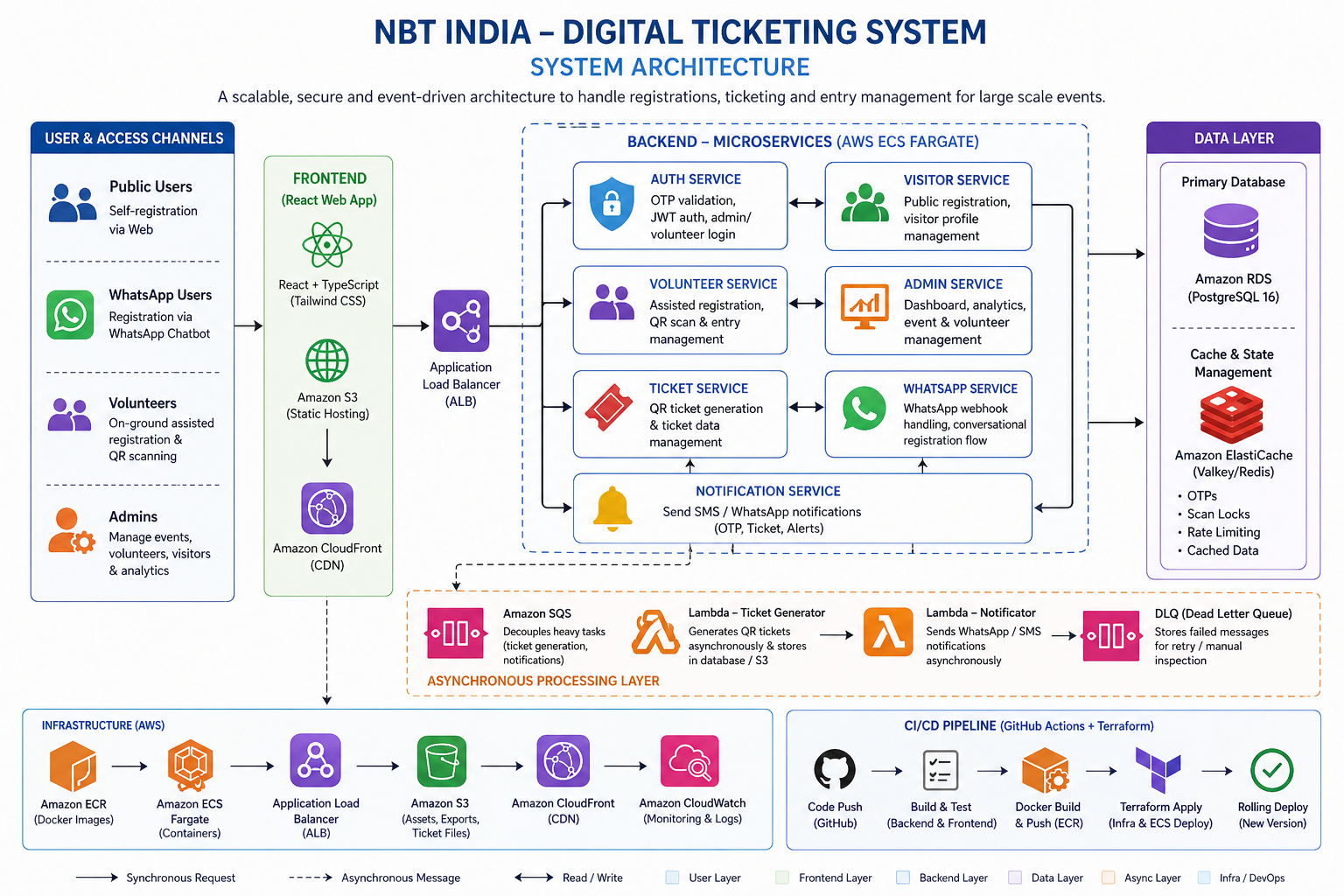
Designing systems for large-scale public events is one of the most practical ways to understand real-world backend architecture and system design.
In this case study, we’ll break down how we built a scalable digital ticketing system for Indian Government Trust, capable of handling thousands of users, multiple registration channels, and real-time entry validation.
If you’re learning backend development, cloud, or system design – this is the kind of architecture you should understand.
Problem: Managing High-Traffic Event Systems
Large public events like book fairs introduce several engineering challenges:
- Thousands of concurrent users
- Multiple registration channels (web, WhatsApp, on-ground)
- Real-time QR-based entry validation
- Preventing duplicate entries
- Fast ticket generation and delivery
Traditional monolithic systems often fail due to:
- Poor scalability
- Blocking operations
- Lack of real-time processing
Solution: Scalable Digital Ticketing System Architecture
We designed a microservices-based, event-driven architecture that supports:
- Public self-registration via web
- WhatsApp chatbot-based registration
- Volunteer-assisted on-ground registration
- QR-based digital ticketing
- Real-time entry scanning system
- Admin dashboard with analytics
High-Level System Architecture
This system follows a modern microservices architecture using AWS cloud services, ensuring scalability, reliability, and performance.
Frontend Architecture (React + CDN)
he frontend is built using:
- React 18 + TypeScript
- Vite for fast builds
- Tailwind CSS for UI
Deployed using:
- Amazon S3 (static hosting)
- CloudFront CDN (global distribution)
Benefits:
- Fast loading across devices
- Mobile-first experience
- Highly scalable static delivery
Backend Architecture (Microservices on AWS)
We implemented a domain-driven microservices architecture, where each service handles a specific responsibility.
Core Microservices:
- Auth Service → OTP login, JWT authentication
- Visitor Service → Registration & user data
- Volunteer Service → On-ground workflows & QR scanning
- Admin Service → Dashboard & analytics
- Ticket Service → QR ticket generation
- WhatsApp Service → Chat-based registration flow
Why Microservices?
- Independent scaling
- Fault isolation
- Faster deployments
- Better maintainability
AWS Cloud Architecture
This project leverages a cloud-native architecture on AWS:
- ECS Fargate → Serverless container deployment
- Application Load Balancer → Traffic routing
- Amazon RDS (PostgreSQL) → Primary database
- ElastiCache (Redis) → Caching & locking
- SQS + Lambda → Asynchronous processing
If you want to learn how to build systems like this, check our – Backend & AWS Course
Event-Driven Architecture (Core Scaling Strategy)
A key design decision was to use an event-driven architecture with AWS SQS.
Asynchronous workflows include:
- Ticket generation
- Notification delivery (WhatsApp/SMS)
Flow:
- User registers
- Event pushed to SQS
- Lambda processes ticket generation
- Notification service sends ticket
Benefits:
- Non-blocking APIs
- High scalability
- Retry & failure handling
- Decoupled services
QR-Based Entry System (Real-Time Validation)
At event entry points:
- Volunteers scan QR codes
- Backend validates instantly
- Redis prevents duplicate scans
Anti-Duplication Logic:
- Redis locks ensure one-time entry
- Fast in-memory validation
Result:
- High-speed entry flow
- Fraud prevention
- Accurate tracking
Admin Dashboard (Real-Time Analytics)
Admins can:
- Monitor visitor registrations
- Track real-time entries
- Manage volunteers
- Export data
Built using:
- React + Recharts
Security & Performance
We implemented:
- OTP-based authentication
- JWT authorization
- Rate limiting
- Redis-based locking
Performance Enhancements:
- CDN delivery (CloudFront)
- In-memory caching (Redis)
- Async processing (SQS + Lambda)
CI/CD Pipeline (Zero Downtime Deployments)
Using GitHub Actions + Terraform:
Backend:
- Build → Docker → Push to ECR
- Terraform → ECS rolling deployment
Frontend:
- Build → Deploy to S3
- CloudFront cache invalidation
Why This System Scales
This architecture is optimized for:
✔ High Traffic
Handles thousands of concurrent users
✔ Reliability
Async processing prevents system failures
✔ Flexibility
Supports multiple registration channels
✔ Performance
Low latency with caching + CDN
System Design Takeaways
If you’re learning backend or system design:
- Microservices are useful for domain separation
- Event-driven architecture is critical for scale
- Redis is essential for real-time systems
- Cloud-native design simplifies scaling
- Async processing improves performance
Final Thoughts
This is not just a project – it’s a real-world system design case study.
If you want to become a backend engineer, you need to go beyond tutorials and understand how systems like this are actually built.
Checkout our programs – Backend & AWS Course