
Architecture Behind thesagarpanwar.com (Real-World Backend + AWS System Design)
 Sagar Panwar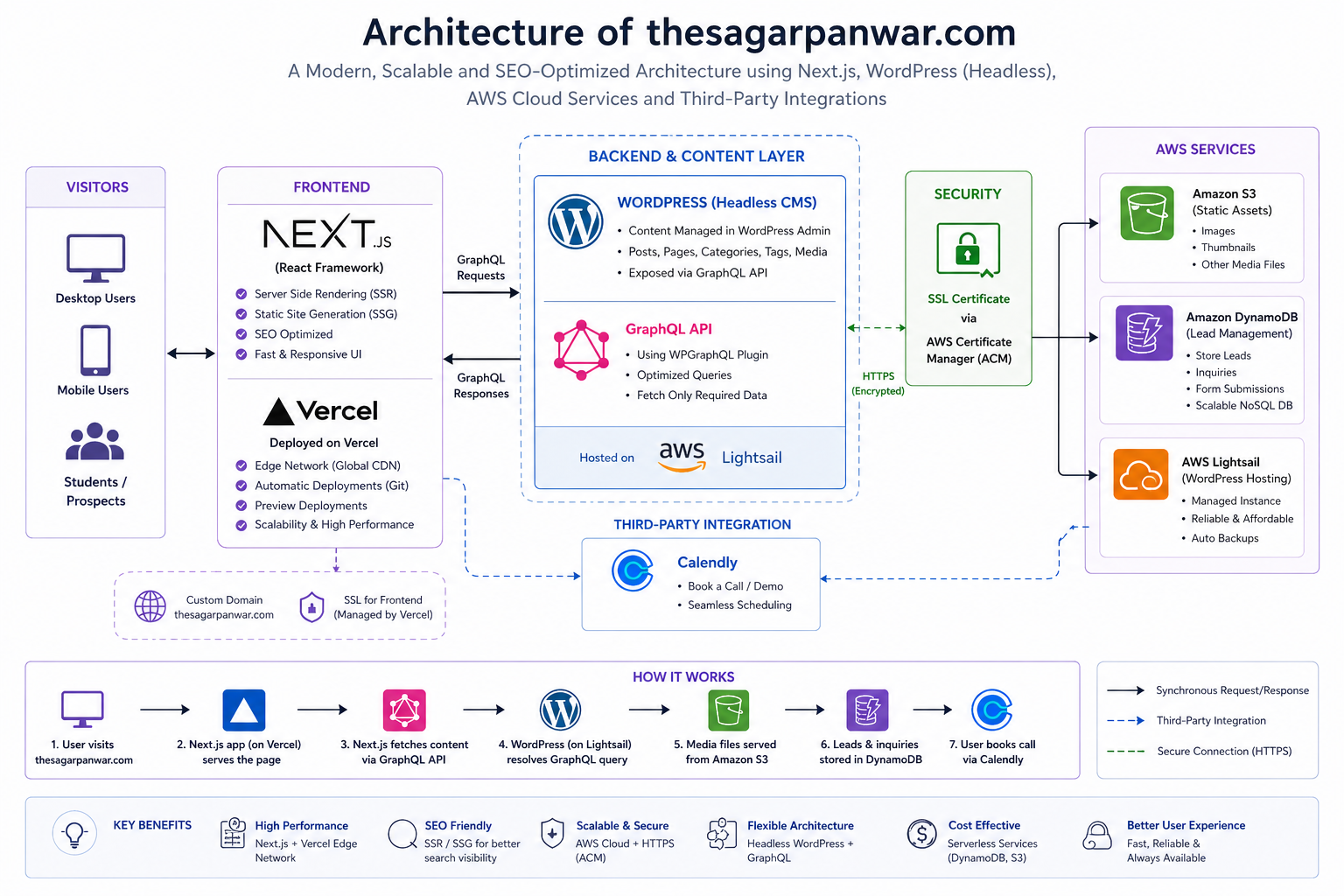
Building a modern web platform today is not just about writing code—it’s about designing systems that are scalable, fast, and production-ready.
In this blog, I’ll break down the architecture behind thesagarpanwar.com
This is a real-world implementation of a modern full-stack + cloud-based system, combining frontend performance, backend flexibility, and AWS infrastructure.
System Overview
The platform is designed with a decoupled architecture, separating:
- Frontend (performance + SEO)
- Content system (blog)
- Backend services (data + leads)
- Cloud infrastructure (AWS)
This ensures:
- Faster performance
- Independent scaling
- Clean separation of concerns
Frontend Architecture (Next.js + Vercel)
The frontend is built using Next.js, deployed on Vercel.
Why Next.js?
- Server-side rendering (SSR) for SEO
- Static generation for speed
- Built-in routing & optimization
Why Vercel?
- Edge delivery (fast global performance)
- Automatic deployments (CI/CD built-in)
- Zero infrastructure management
Key Benefits:
✔ Lightning-fast page loads
✔ SEO-friendly rendering
✔ Seamless deployment pipeline
Blog System (Headless WordPress + GraphQL)
Instead of coupling content with frontend, the blog uses a headless CMS approach.
Setup:
- WordPress hosted on AWS Lightsail
- Content exposed via GraphQL API
Why Headless WordPress?
Traditional WordPress:
- Slow
- Hard to scale
- Limited frontend control
Headless approach:
- Use WordPress only for content
- Fetch data via APIs
- Render using Next.js
GraphQL Advantage
Using GraphQL instead of REST:
- Fetch only required data
- Reduced payload size
- Better performance
This is critical when building SEO-driven blog systems
AWS Infrastructure (Backend + Storage)
The backend services are powered by AWS components for reliability and scalability.
Secure API Layer
- SSL certificates managed via AWS Certificate Manager
- Ensures secure HTTPS communication
Important for:
- User trust
- SEO ranking
- Data protection
Data Storage (DynamoDB)
Leads and user data are stored in:
- Amazon DynamoDB (NoSQL database)
Why DynamoDB?
- Serverless scaling
- Low latency
- No schema constraints
Used for:
- Lead capture
- Student inquiries
- Form submissions
Read More (AWS): Understanding Serverless and AWS Lambda
Asset Storage (Amazon S3)
All static assets like images are stored in:
- Amazon S3
Benefits:
- Highly durable storage
- Scalable
- Optimized for web delivery
Lead Conversion Layer (Calendly Integration)
To simplify user interaction:
- Calendly is integrated for booking demo calls
Why this matters:
- Reduces friction in conversion
- Improves user experience
- Automates scheduling
Performance & Optimization
This architecture ensures:
Fast Frontend
- Next.js + edge deployment
Optimized Content Delivery
- GraphQL + headless CMS
Scalable Backend
- DynamoDB + AWS services
Architecture Pattern Used
This system follows:
Decoupled / Headless Architecture
Combined with:
- Serverless backend
- CDN-based frontend delivery
- API-driven content system
Real-World Learning Perspective
This is not a tutorial setup—it reflects how modern production systems are built.
If you’re learning backend or cloud, you should understand:
- Why decoupling matters
- When to use GraphQL
- How serverless databases work
- How frontend and backend scale independently
SEO Strategy Behind This Architecture
This system is also optimized for:
- Fast page load → better rankings
- SSR rendering → improved indexing
- Content-driven traffic via blogs
Blogs internally link to course pages for conversion
Final Thoughts
The goal of this architecture was simple:
👉 Build a system that is fast, scalable, and easy to evolve
Instead of over-engineering, the focus was on:
- Practical scalability
- Clean separation
- Real-world usability
Want to Build Systems Like This?
If you’re interested in learning:
- Backend development
- AWS cloud
- Real-world system design
Explore the Full Stack Backend + AWS Program